04-28-16
Night Sky Photography
A Beginner's Experience
Living in San Francisco, I’ve often dismissed stargazing out of hand due simply to the amount of light pollution in the area. It turns out, though, that my Sony DSC-RX100 is quite capable of producing great night sky images, and so I became determined to at least give it a try. But where could I go to escape the light and try my hand at night sky photography? Somewhere with relatively easy access (e.g., not too hard to find my way at night) but with a dark sky?
Having recently hiked the Mt. Burdell Open Space Preserve, I had a hunch it would fit the bill. After sunset, I walked a short distance into the park and waited for the sky to darken. I pulled up SkyView on my phone to start familiarizing myself with that night’s main features, setting Twilight to maximum intensity so as to preserve my night vision. I was able to quickly identify two bright objects in the sky: Jupiter and Sirius.
I also got the camera and tripod ready to go. Earlier in the day I had prepared the camera with the following settings recommended by Lonely Speck:
- Manual Focus
- White Balance: Daylight or Custom: 3900K
- Long Exposure NR: Off
- SteadyShot: Off
- MF Assist: On
- Self-Timer: 2 seconds
- Manual Exposure
- 20 seconds
- f/1.8
- ISO 1600
With the sky still quite blue, I fired off some test shots to get used to manual focusing. When facing west, I chose to focus on Sirius. In other directions I would occasionally re-focus using Jupiter. I was immediately impressed with the results, which only got better as the sky got darker. In one shot of Jupiter, a satellite crossed part of the frame.
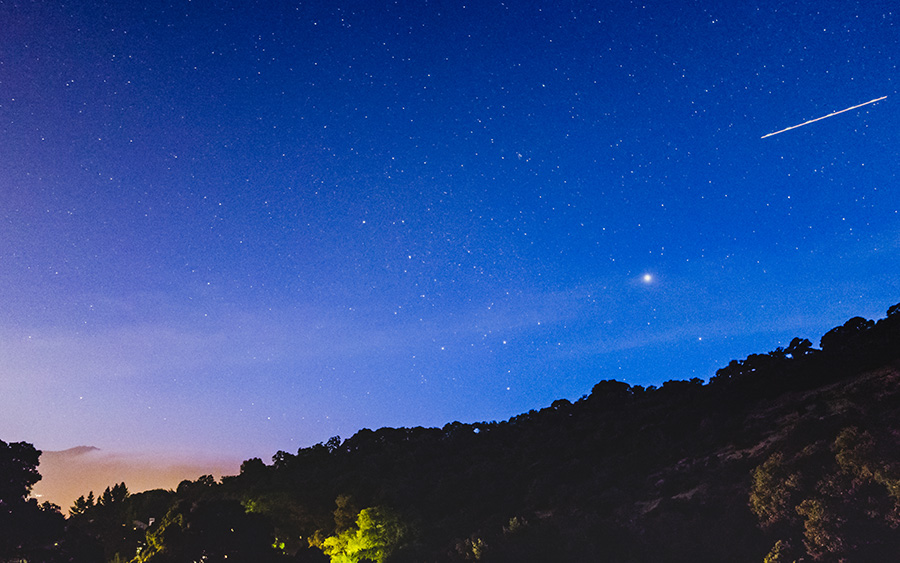
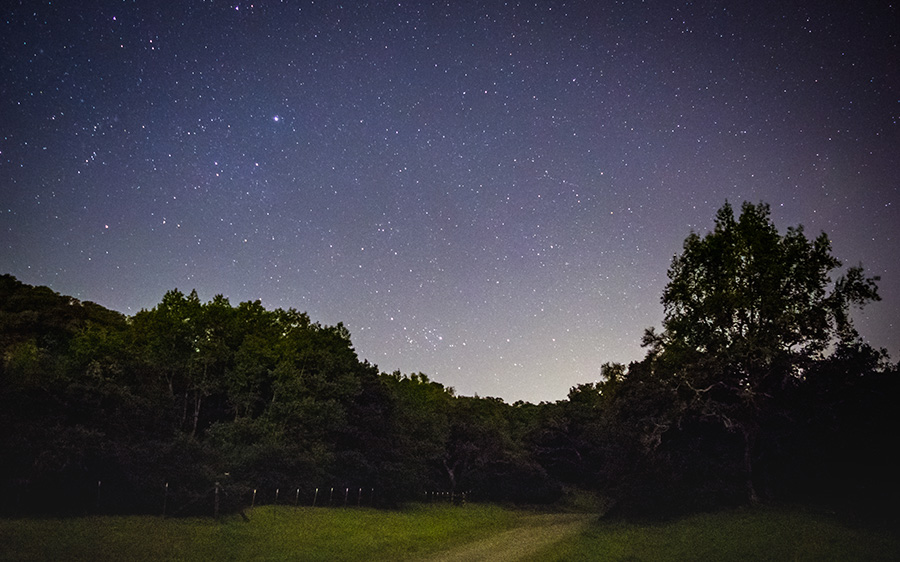
Overall, I was really pleased with the RX-100’s performance, and the ease of focusing. I did encounter some difficulties, however. The lcd screen must be turned on for focusing and reviewing shots. Even on its dimmest setting the screen was pretty bright. I’m not sure what to do about this, but I’ve considered cutting out a piece of red film to cover it. Another issue was that as I moved the camera’s position using the tripod’s ball head, I probably nudged the control ring, causing some out-of-focus shots. In the future I’ll need to be careful handling the camera, or be sure to re-focus after setting the orientation.
My next goal? Photograph the Milky Way!